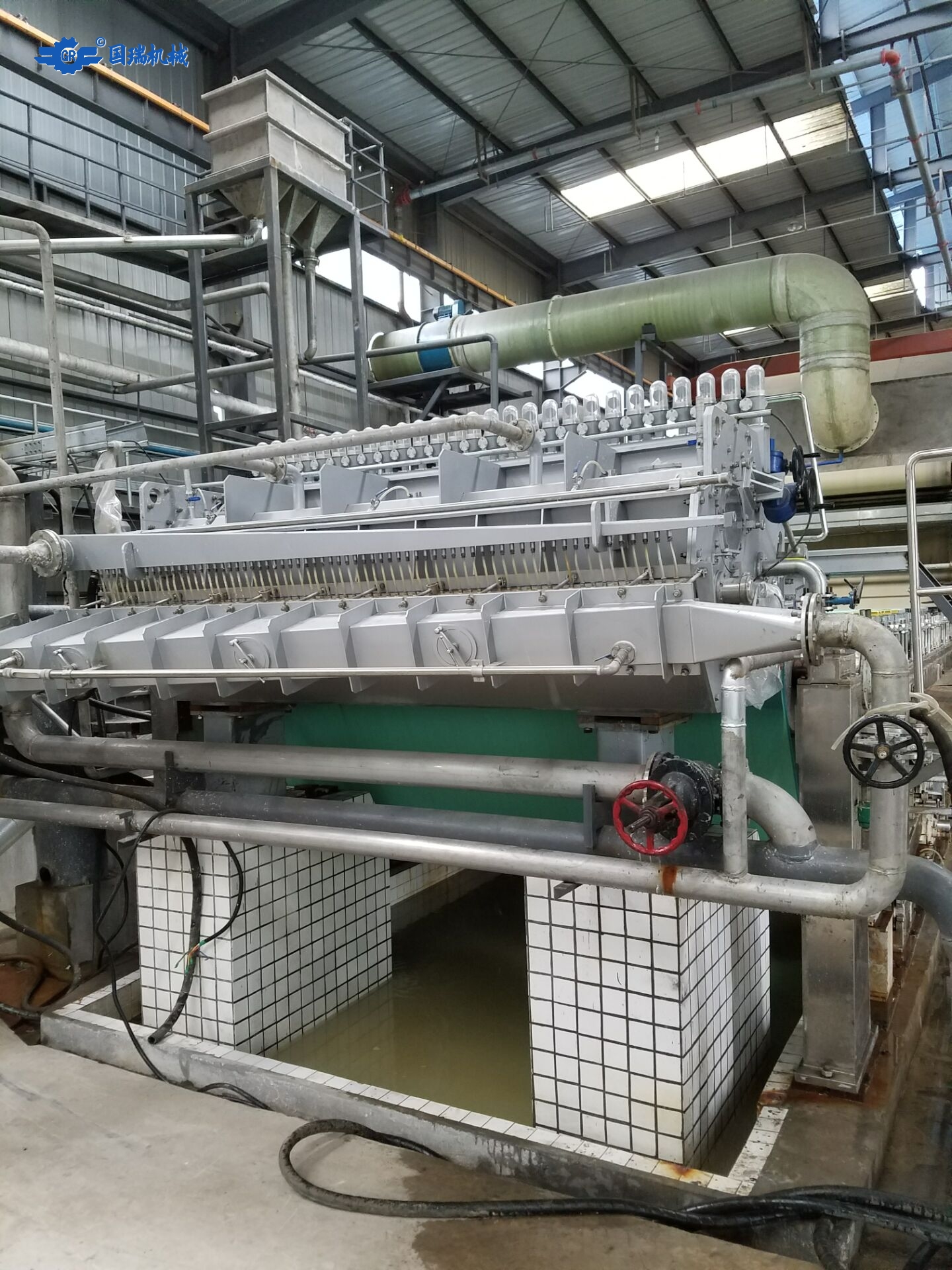
The headbox is a core component of the paper machine, which achieves uniform distribution and precise ejection of pulp through the synergistic effect of three parts: the pulp distributor, the weir tank and the slice. Its structure includes components such as a turbulence generator and a dilution water device, which can adjust the pulp flow rate, pressure and fiber dispersion, and directly affect the basis weight distribution and strength properties of paper. It is mainly divided into three types: open type, air-cushion type and hydraulic type.
The headbox consists of three core components:
Pulp distributor: Adopts a cylindrical structure to eliminate pressure differences, is equipped with a dilution water device to realize automatic lateral basis weight adjustment, and attenuates pulp flow pulses through flexible branch pipes.
Weir tank: Incorporates a balance chamber to mix pulp flow and eliminate pressure pulsations, and is fitted with a thermal compensation system to balance thermal differential deformation.
Slice: Equipped with 61 fine adjusters at a spacing of 102mm, the edge flow channel can adjust the fiber alignment direction, and the lip width reaches 6180mm.
The turbulence generator adopts a combined design of fixed and movable sections, and controls the turbulence intensity by adjusting the cross-sectional area of the flow channel, maintaining an effective turbulence level within the flow rate range of 300-800m/min.
Open headbox: Suitable for medium and low speed paper machines, adopts a square cone main pipe pulp distribution structure, with a manual adjustment range of 0-100mm.
Air-cushion headbox: Equipped with an air cushion to stabilize the liquid level, adapted to cylindrical pulp distributors, and the basis weight fluctuation is improved by more than 40%.
Hydraulic headbox: Adopts a spiral hole homogenizing roll and integrates a step diffuser to achieve high-efficiency flow rectification.
Multi-layer forming headbox: Produces multi-layer composite paper sheets through layered pulp distribution technology.
It forms an interlocking system with dewatering elements:
The forming board controls the initial dewatering rate and eliminates fiber flocculation.
The doctor blade and vacuum box cooperate to form vacuum suction for dewatering.
The vacuum couch roll increases the dryness of the wet paper web to 16-22%.
In the production process:
The pulp forms micro-turbulence through the step diffuser.
The matching precision between pulp speed and wire speed reaches ±0.05m/s.
Fully automatic cross-machine profile control is realized through the QCS system.