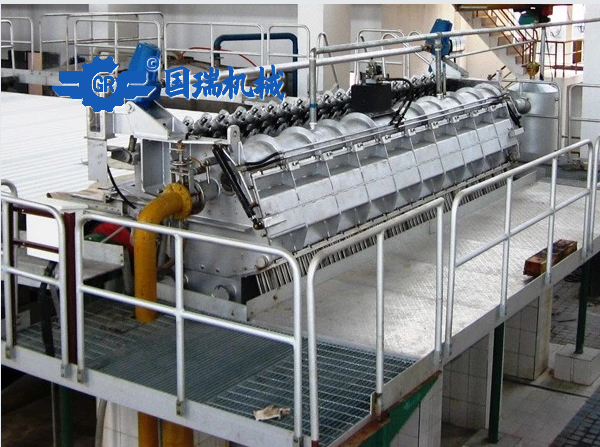
In paper production, the headbox is one of the most critical pieces of equipment that determines the quality of the paper’s fiber structure. It is responsible for achieving uniformity and controllability of paper properties. It directly affects the paper’s MD/CD strength ratio, tensile or breaking length, porosity, formation, and retention.
The future development goals of papermaking — including continuous improvements in machine speed, efficiency, and paper quality — impose a series of requirements for the upgrading of existing headboxes. The operating performance of a headbox is closely related to paper machine speed and efficiency. At the same time, improvements in headbox performance should also be considered in combination with the quality of the paper’s fiber structure (uniformity of basis weight distribution and fiber orientation). Higher demands must also be placed on mechanical manufacturing under high-speed conditions.
The development of headboxes has been driven by the continuous increase in paper machine speeds. From the flood gate type headbox, open roll headbox, and air-cushion roll headbox to the modern hydraulic headbox, each generation has been developed to meet higher speed requirements. Therefore, the selection of a headbox should also be based on the design speed of the paper machine.
Although there are many structural types of headboxes, functionally they all consist of three main components: the manifold, the homogenizing device, and the nozzle. Headbox design is centered around these three components.
At present, headboxes can generally be divided into two categories:
Roll-type headboxes (open type, air-cushion type).
Hydraulic headboxes (full-flow type, semi-hydraulic type).
Both types of headboxes focus on flow velocity when solving the three key issues: flow distribution, homogenization, and jet delivery.
The roll-type headbox uses rotating perforated rolls as homogenizing elements. Its homogenization mechanism is that the stock flow contracts and expands when passing through the holes of the roll, creating turbulence that disperses the fibers. Although this turbulence is relatively large in scale and low in energy, it matches the agitation generated by the dewatering elements of the Fourdrinier section, resulting in satisfactory formation. Therefore, it is widely used in medium and low-speed paper machines.
The air-cushion roll headbox was developed to accommodate higher speeds and wider operating ranges. Compressed air is introduced into a closed headbox, so that the static pressure inside is composed of a constant stock level (generally similar to the diameter of the homogenizing roll) and an adjustable air-cushion pressure.By adjusting the air-cushion pressure, the jet velocity can be regulated. Since the stock level is relatively low, the flow velocity through the perforations of the homogenizing roll is relatively high, with the approach flow velocity in the headbox ranging from 0.27 to 0.45 m/s.
The air-cushion roll headbox is suitable for paper machines with operating speeds of 180–450 m/min.