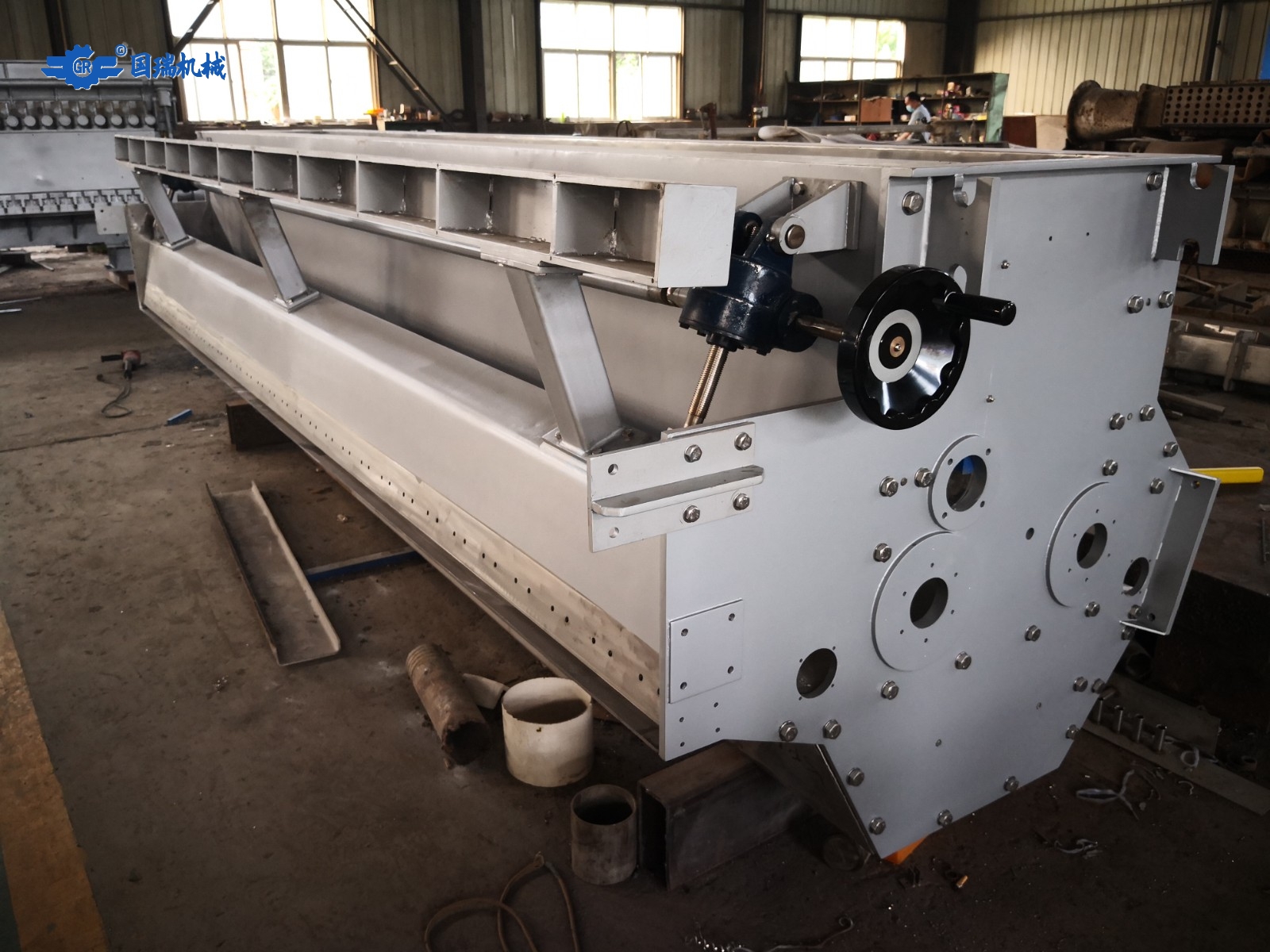
Hydraulic headboxes were developed alongside high-speed twin-wire paper machines. Owing to the short forming surface of twin-wire formers — in other words, the extremely short forming time of the paper web — the web is essentially "set" once the stock jet impinges on the wire. Therefore, the stock must be uniformly distributed within the headbox.
High-efficiency, compact, laterally uniform single-inlet tapered headers and fixed homogenizing devices are commonly adopted. High-velocity stock flow generates intense micro-turbulence through cross-sectional or geometric changes of fixed elements, dispersing the stock suspension. With stable longitudinal flow and no cross currents inside a hydraulic headbox, the basis weight profile of the sheet can be adjusted by regulating the stock concentration of the header tubes, achieving better results than locally modifying the lip opening with 微调 rods. This is an advantage unattainable by roll-type headboxes.
The jet velocity of a hydraulic headbox is controlled by the dynamic head of a variable-speed stock pump, enabling adaptation to very high machine speeds. Since the homogenizing effect of fixed elements relies on high flow velocities (approximately 1.5 m/s), the machine speed should generally not be less than 300 m/min. Due to the use of fixed homogenizing elements with geometric dimensions designed for specific ranges, hydraulic headboxes are suitable for paper machines with small speed variations and relatively uniform product grades.
To expand the application scope and reduce sensitivity to inlet stock pulsation, semi-hydraulic headboxes have been developed. Combining the merits of hydraulic and air-cushion headboxes, they operate at speeds ranging from 300 to 1000 m/min and can be applied to fourdrinier paper machines.
In paper production, the uniformity of cross-directional bone-dry basis weight is one of the most critical indicators of paper quality. A headbox must maintain stable stock flow properties and consistent basis weight distribution. Enhanced white water dilution is generally employed to control cross-directional basis weight, achieving excellent uniformity of cross-directional bone-dry basis weight distribution, typically through multi-point dilution regulation.
Dilution water can be thoroughly and ideally mixed with the stock flow in each branch of the multi-row headers of the headbox. Optimal dilution water dosage reduces sensitivity to external disturbances such as variations in retention, ensuring safe operation over the widest possible range. Multi-row headers and carefully designed devices for box balancing enable smooth Gaussian basis weight distribution curves through concentration regulation, delivering ideal control performance.
The most economical dilution water is paper machine white water. Meanwhile, stable retention in the wet end is desirable. Benefits of dilution control include high basis weight controllability, narrow frequency density bands, and precise, fully independent control of fiber orientation. Furthermore, the adoption of dilution control has heightened the importance of cross-directional basis weight measurement and accurate profile mapping.